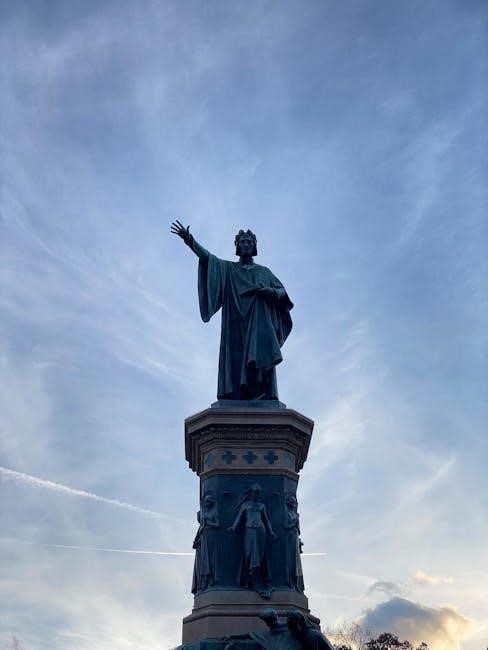
Dante’s Inferno vividly portrays a journey through Hell, guided by Virgil, exploring sin, punishment, and divine justice within a complex allegorical framework.
Historical Context of the Poem
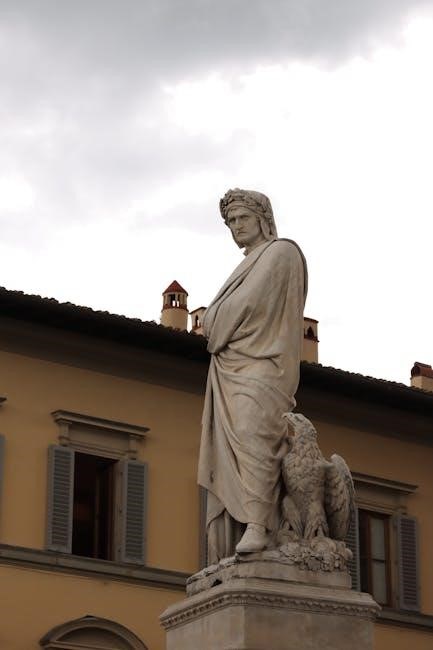
Dante Alighieri penned Inferno in the early 14th century, a period of intense political and social upheaval in Florence and Italy. The poem reflects the conflicts between Guelphs and Ghibellines, factions vying for power, and Dante’s own exile from Florence in 1302 due to his political affiliations.
This exile profoundly shaped his worldview and fueled the poem’s critical commentary on contemporary politics and corruption. Medieval cosmology, with its hierarchical structure of Heaven, Hell, and Purgatory, provided the framework for Dante’s imagined afterlife.
Furthermore, the poem draws heavily from classical literature, particularly Virgil’s Aeneid, reflecting the Renaissance’s rediscovery of ancient texts and philosophies. Understanding this historical backdrop is crucial for interpreting the poem’s allegorical layers and Dante’s pointed criticisms.
Dante Alighieri: Life and Influences
Dante Alighieri (1265-1321) was a Florentine poet, writer, and politician whose life was marked by both intellectual achievement and personal tragedy. His early life involved studies in Florence and possibly Bologna, immersing him in classical and philosophical thought. His love for Beatrice Portinari profoundly influenced his writing, becoming a symbol of divine love and inspiration.
Politically active, Dante’s involvement in Florentine politics led to his exile, a pivotal event shaping Inferno. Key influences included Virgil, whose epic poem served as a model, and scholastic philosophers like Thomas Aquinas.
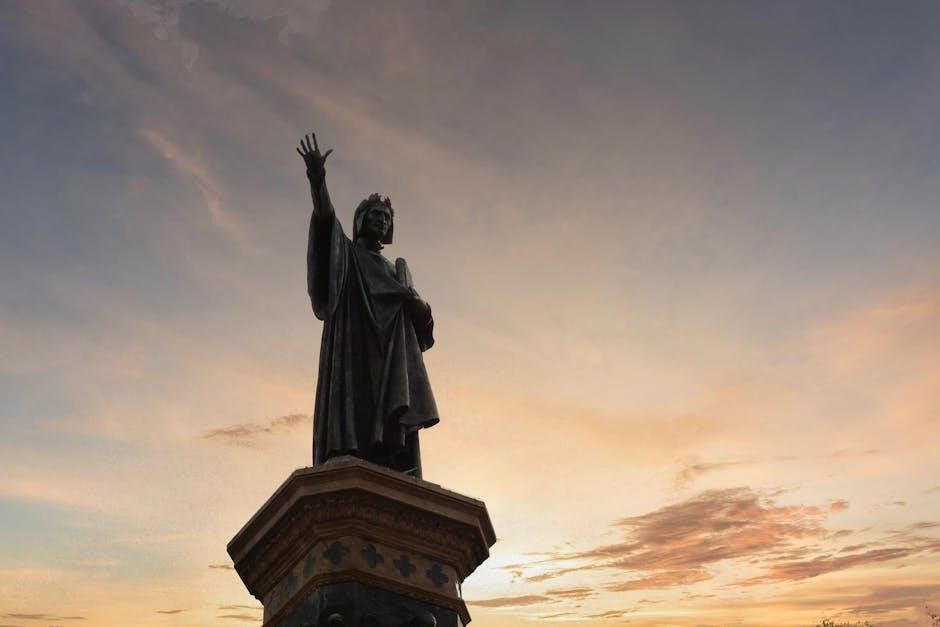
These influences, combined with his personal experiences, fueled his creation of a complex and allegorical masterpiece exploring themes of sin, justice, and redemption.
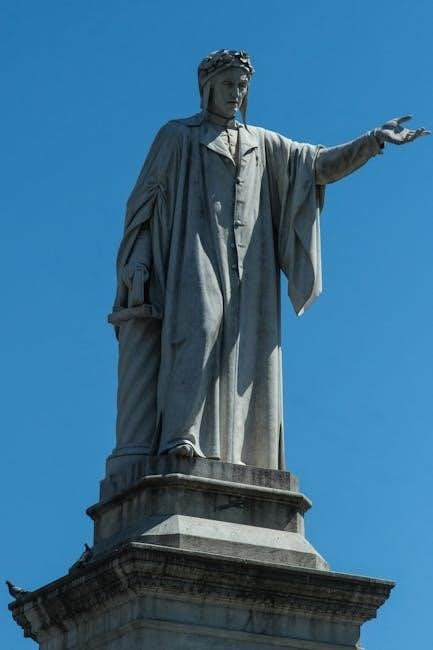
The Structure of Hell: A Cantica Overview
Inferno, the first cantica, details Dante’s descent through nine concentric circles of Hell, each reserved for different categories of sin.
The Three Circles: Upper, Middle, and Lower Hell
Dante’s Hell is ingeniously structured into three primary realms, each reflecting a deepening severity of sin and corresponding punishment. Upper Hell encompasses sins of incontinence – those driven by passion and lacking deliberate malice, including lust, gluttony, greed, and wrath.
Middle Hell houses sins of violence, categorized into violence against neighbors, self, and God, representing a deliberate rejection of reason and divine order. Finally, Lower Hell, the deepest and most horrific region, is reserved for sins of fraud and treachery – intellectual sins born of cold, calculated malice.
This tripartite division isn’t merely geographical; it signifies a moral hierarchy, with sins escalating in wickedness as one descends further into the abyss, mirroring a corruption of the soul.
The Nine Circles: A Detailed Breakdown
Dante’s Inferno meticulously maps Hell into nine concentric circles, each dedicated to a specific category of sin and its corresponding torment. Circle 1, Limbo, houses the virtuous pagans. Circle 2 punishes lustful souls, tossed by relentless winds. Circle 3 holds gluttons, subjected to eternal rain and filth.
Circles 4-6 contain those guilty of greed, wrath, and heresy, respectively. Circles 7, 8, and 9 descend into increasingly heinous sins: violence, fraud, and treachery. The eighth circle, Malebolge, is divided into ten ditches for various fraudulent acts. At the very center, in Circle 9, lies Lucifer, frozen in ice, betraying God.

Key Characters and Their Significance
Dante and Virgil embark on a symbolic descent, representing humanity and reason, respectively, navigating the realms of sin and seeking spiritual understanding.
Dante, the Pilgrim
Dante Alighieri, as the poem’s protagonist, represents all of humanity lost in sin. Midway through life, he finds himself astray in a dark wood, symbolizing spiritual crisis. His journey through Inferno isn’t merely a physical descent but a profound allegorical exploration of the soul’s path to redemption.
Initially, Dante is a vulnerable and fearful figure, overwhelmed by the horrors of Hell. However, through his encounters with various sinners and guided by Virgil, he gradually gains understanding and strength. He embodies the potential for moral growth and the struggle against temptation. His personal journey mirrors the universal human experience of confronting one’s own flaws and seeking divine grace.
Dante’s emotional responses to the suffering he witnesses are crucial, highlighting the poem’s emphasis on empathy and the consequences of sin.
Virgil: The Guide Through Inferno
Virgil, the renowned Roman poet, serves as Dante’s guide through the harrowing depths of Inferno. Appointed by Beatrice, he embodies human reason and wisdom, leading Dante through the realms of sin and suffering. However, Virgil’s authority is limited; as a pagan, he cannot enter Paradise, representing the limitations of human intellect in achieving divine understanding.
He expertly navigates the complex landscape of Hell, offering Dante protection from demons and explaining the punishments inflicted upon the damned. Virgil’s calm demeanor and rational explanations contrast sharply with the chaotic and terrifying environment. He represents classical learning and provides a framework for Dante’s moral and spiritual development.
His guidance is essential for Dante’s journey, yet ultimately, divine grace is needed for complete salvation.
Lucifer: The Fallen Angel at the Center
Lucifer, once the most beautiful of angels, resides at the very heart of Hell, frozen in a lake of ice – a chilling depiction of ultimate evil and isolation. Dante portrays him not as an actively malevolent force, but as a being utterly devoid of warmth and vitality, trapped in a self-imposed exile. He is a grotesque parody of God, embodying the complete rejection of divine love.
With three faces, each a different color – red, yellowish-white, and black – Lucifer eternally chews on Judas Iscariot, Brutus, and Cassius, the ultimate betrayers. This placement signifies the gravity of treachery as the worst of all sins.
His immobility and frozen state symbolize the complete absence of love and the finality of damnation.
The Concept of Contrapasso
Contrapasso, central to Inferno, dictates punishments mirroring the sins committed in life; a divine justice where suffering reflects earthly transgressions precisely.
Law of Contrapasso: Punishment Fitting the Crime
The core principle governing Hell’s justice in Dante’s Inferno is contrapasso – a meticulously crafted system where punishment directly reflects the nature of the sin. This isn’t random infliction of pain, but a poetic and symbolic retribution.
Dante believed that the suffering in each circle of Hell must be intimately connected to the wrongdoing that earned the soul its place there. The law operates on three levels: contrasto (opposite), analogia (analogy), and parodia (parody).
Essentially, contrapasso ensures that the damned are tormented not just by pain, but by a suffering that embodies the very essence of their sin, creating a chillingly appropriate and eternally fitting consequence.
Examples of Contrapasso in Different Circles
Consider the lustful souls in Circle 2, endlessly buffeted by winds – mirroring their lack of control over their desires in life. Gluttons in Circle 3 lie in filth, tormented by rain and Cerberus, reflecting their excessive indulgence.
The wrathful and sullen, submerged in the muddy Styx, fight amongst themselves (wrathful) or choke on their own bitterness (sullen). Heretics, enclosed in fiery tombs, symbolize their burning, false beliefs. Violent souls suffer immersion in boiling blood, the degree depending on their violence.
Fraudulent souls endure complex and ironic punishments, while traitors are frozen in ice, utterly isolated – a chilling echo of their betrayal.
Sin and Punishment in Detail
Inferno meticulously details how each sin warrants a specific, often ironic, punishment within Hell’s structure, reflecting Dante’s vision of divine justice.
Lustful Souls (Circle 2)
Within the second circle of Inferno, Dante encounters the souls of those overcome by lust – individuals who prioritized carnal desire above reason and spiritual devotion. These souls are endlessly buffeted by violent, tempestuous winds, symbolizing the lack of control they exhibited in life and the turbulent nature of their passions.
Notable among them are figures like Cleopatra, Helen of Troy, and Paris, historical figures renowned for their amorous exploits. Their eternal punishment reflects the unrestrained indulgence they pursued while living. Dante emphasizes that their sin wasn’t simply sexual, but a perversion of love, a misdirection of affection away from the divine and towards fleeting earthly pleasures. The relentless storm embodies the ceaseless agitation of their unfulfilled desires, a perpetual torment mirroring their earthly failings.
Gluttonous Souls (Circle 3)
Descending into the third circle, Dante and Virgil confront the gluttonous souls, submerged in a vile, freezing slush perpetually rained upon by foul-smelling filth. Cerberus, the three-headed dog of Greek mythology, guards this dismal realm, tearing at the sinners with its claws, mirroring their base appetites in life.
These souls, consumed by excessive indulgence, lie wallowing in the muck, representing a degradation of the human spirit. Their punishment isn’t merely physical discomfort, but a symbolic representation of their lack of self-control and their reduction to a purely animalistic existence. Dante highlights the dehumanizing effect of unchecked desire, portraying them as stripped of dignity and reduced to base instincts. The relentless rain and cold emphasize the squalor and hopelessness of their eternal state.
Wrathful and Sullen Souls (Circle 5)
Within the murky depths of the fifth circle, Dante witnesses the tormented souls of the wrathful and the sullen. Above, the River Styx churns with a constant, furious battle between the wrathful, eternally fighting each other on the surface. Below the waters, submerged and gurgling, lie the sullen – those consumed by bitterness and resentment.
Dante emphasizes the contrasting yet equally destructive nature of outward rage and inward despair. The wrathful express their anger endlessly, while the sullen suffocate in their own negativity. This circle embodies the dangers of uncontrolled emotion, demonstrating how both explosive outbursts and repressed feelings lead to spiritual decay. The Styx itself symbolizes the stagnation and bitterness that define this realm, a fitting punishment for souls consumed by destructive passions.
Heresy (Circle 6)
Descending into the sixth circle, Dante encounters a desolate landscape of open tombs – the eternal prison of heretics. These souls, who denied the immortality of the soul during their lives, now reside in unhallowed graves, utterly devoid of hope for resurrection. The heat within this circle is intense, mirroring the burning conviction of their false beliefs.
Epicurus and his followers, who espoused materialistic philosophies, are specifically condemned here. Dante’s depiction of heresy isn’t merely theological disagreement; it’s a rejection of the fundamental order of creation and the promise of eternal life. The sealed tombs symbolize the heretics’ self-imposed spiritual confinement, a punishment reflecting their denial of the soul’s journey beyond earthly existence. This circle underscores the gravity of challenging divine truth.
Violence (Circles 7, 8, and 9)
The seventh, eighth, and ninth circles house those who committed acts of violence, categorized by their targets. Circle seven contains the violent against neighbors, tyrants, and murderers, immersed in a river of boiling blood – the Phlegethon – its depth corresponding to the severity of their crimes. Circle eight, Malebolge, is a complex, ditch-filled landscape punishing the violent against fraud, encompassing ten distinct bolge (pouches) for various sins.
Finally, circle nine, the deepest and most horrific, is reserved for the violent against God, nature, and art – giants, blasphemers, and sodomites. This culminates in the frozen lake of Cocytus, where betrayers are encased in ice, reflecting the coldness of their treachery. The escalating severity mirrors the increasing offense against divine order.
Fraud (Circles 8 and 9)
Circles eight and nine detail the punishments for fraudulent souls, considered a particularly heinous sin due to the abuse of intellect and trust. Malebolge (Circle 8) houses ten bolge, each punishing a different type of fraud – panderers, seducers, flatterers, soothsayers, grafters, hypocrites, thieves, fraudulent counselors, schismatics, and falsifiers. These punishments are often grotesque and ironic, reflecting the nature of the deceit.
Circle nine, the lowest level, is reserved for treachery – fraud against those to whom one owes loyalty. Divided into four rounds – Caina, Antenora, Ptolomea, and Judecca – it punishes betrayers of kin, country, guests, and lords respectively, frozen in the icy lake of Cocytus, symbolizing the coldness of their betrayal.
Treachery (Circle 9)
The ninth and final circle of Hell, reserved for treachery, embodies the ultimate sin – the deliberate betrayal of trust. This realm, Cocytus, is a frozen lake, symbolizing the cold, heartless nature of treachery. It’s divided into four zones, each punishing a specific type of betrayer.
Caina holds those who betrayed kin, Antenora those who betrayed their country, Ptolomea those who betrayed guests, and Judecca, the deepest and most horrific, houses those who betrayed their lords. Within Judecca, Lucifer himself is imprisoned, eternally chewing on Judas Iscariot, Brutus, and Cassius – the ultimate betrayers of divine and earthly authority. The frozen isolation reflects the complete severance from love and warmth.
Themes Explored in Inferno
Inferno profoundly examines justice, divine retribution, sin, and the potential for redemption, interwoven with sharp political commentary and layered allegorical meanings.
Justice and Divine Retribution
Central to Inferno is the concept of divine justice, meticulously enacted upon the souls residing in Hell. Dante doesn’t portray arbitrary punishment; instead, each torment is a direct consequence of the sins committed during life on Earth. This isn’t merely vengeance, but a structured system reflecting God’s perfect order and moral law.
The poem suggests that sin corrupts the soul, distancing individuals from God, and Hell serves as the ultimate consequence of rejecting divine grace. Punishments aren’t inflicted because God is wrathful, but because the nature of sin itself demands a fitting response. This framework emphasizes the importance of free will and accountability for one’s actions, highlighting the gravity of moral choices and their eternal repercussions.
Sin and Redemption
While Inferno primarily depicts the consequences of sin, the overarching narrative of the Divine Comedy—of which it is the first part—ultimately points towards the possibility of redemption. The journey through Hell isn’t an end in itself, but a necessary prelude to Purgatory and Paradise. Dante’s descent reveals the depths of human depravity, serving as a cautionary tale and a catalyst for spiritual awakening.
The poem subtly suggests that recognizing and confronting one’s sins is the first step towards seeking forgiveness and achieving salvation. Though no redemption occurs within Inferno, the very act of witnessing the suffering of the damned compels introspection. The narrative implies that even in the darkest depths, the potential for divine grace remains, offering a glimmer of hope amidst eternal despair.
Political Commentary and Allegory
Inferno is deeply embedded in the political turmoil of Dante’s Florence and Italy. The poem functions as a scathing critique of contemporary political figures and factions, with many historical individuals placed within the various circles of Hell as punishment for their earthly deeds. Dante doesn’t shy away from expressing his personal biases and condemning those he perceived as corrupt or unjust.
Beyond specific political jabs, the entire journey through Hell operates on an allegorical level. It represents the soul’s struggle against sin and the journey towards spiritual purification. Florence, and Italy more broadly, can be seen as allegories for the human condition, plagued by internal conflicts and moral decay. Dante uses the poem to advocate for a strong, just leadership and a return to moral principles.
Literary Devices and Symbolism
Dante masterfully employs allegory, symbolism, vivid imagery, and metaphor throughout Inferno, enriching the poem’s layers of meaning and emotional impact.
Allegory and Symbolism in Dante’s Work
Dante’s Inferno is profoundly allegorical; the entire journey represents the soul’s path to recognizing and rejecting sin. Hell itself symbolizes the spiritual state of sin, and each circle embodies a different vice. Virgil, as Dante’s guide, represents human reason, capable of leading individuals to the edge of understanding divine truth, but insufficient to achieve salvation alone.
Symbolism permeates the poem. The dark wood at the beginning signifies Dante’s moral confusion, while the beasts represent different types of sin. Numbers, like three (representing the Trinity) and nine (representing the circles of Hell), carry symbolic weight. Even the characters encountered aren’t merely individuals, but embodiments of specific sins or virtues, contributing to the poem’s deeper moral and theological message.
The Use of Imagery and Metaphor
Dante’s Inferno masterfully employs vivid imagery and striking metaphors to convey the horrors and moral weight of Hell. The poem is replete with grotesque and visceral descriptions of punishments, designed to shock the reader and emphasize the consequences of sin. Metaphors, such as comparing sin to a debilitating illness, illustrate its corrupting influence on the soul.
The use of light and darkness is particularly significant; darkness symbolizes the absence of God and the despair of the damned, while fleeting glimpses of light hint at hope and divine grace. Dante’s descriptions of the landscape – icy wastelands, fiery pits, and putrid marshes – are not merely physical settings, but reflections of the internal states of the souls inhabiting them, enhancing the poem’s emotional impact.
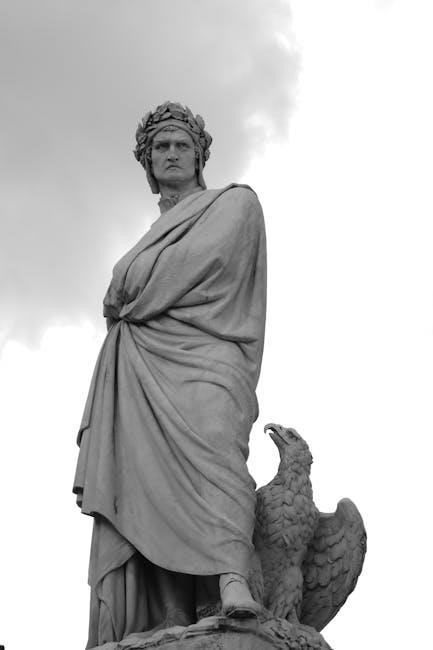
Influence and Legacy of Inferno
Inferno profoundly impacted literature and art, inspiring countless works and continuing to resonate through modern adaptations and interpretations of its themes.
Impact on Literature and Art
Dante’s Inferno has exerted an immense and lasting influence on Western literature and art, becoming a cornerstone of the Western canon. Its vivid imagery and allegorical depth have inspired generations of writers, painters, and sculptors. From Milton’s Paradise Lost to T.S. Eliot’s The Waste Land, echoes of Dante’s journey through Hell can be found throughout literary history.
Visual artists, including Gustave Doré, Sandro Botticelli, and William Blake, have created iconic depictions of scenes and characters from the Inferno, solidifying its visual impact. The poem’s themes of sin, punishment, and redemption continue to be explored in contemporary art and literature, demonstrating its enduring relevance and power to captivate audiences across centuries.
Modern Interpretations and Adaptations
Contemporary interpretations of Dante’s Inferno often focus on its psychological and political dimensions, viewing Hell not merely as a literal place, but as a representation of inner turmoil and societal failings. Adaptations abound, ranging from video games like Dante’s Inferno, which reimagines the journey with action-packed gameplay, to modern novels and films that draw inspiration from its themes and characters.
These adaptations frequently explore the poem’s relevance to current events and anxieties, using its framework to comment on issues such as political corruption, moral decay, and the human condition. The enduring power of the Inferno lies in its ability to be reinterpreted and reimagined for each new generation, ensuring its continued cultural significance.