Instructional Crossword: A Comprehensive Guide
Instructional crosswords blend entertainment with education, offering a unique learning experience through engaging puzzles and clever clue construction. These puzzles are designed
to reinforce knowledge and skills, making them valuable tools for educators and lifelong learners alike. They present a delightful challenge, fostering critical thinking.
What is an Instructional Crossword?
Instructional crosswords are specifically crafted puzzles designed to reinforce learning and educational concepts. Unlike traditional crosswords focused purely on general knowledge, these puzzles integrate subject matter directly into the clues and answers. They serve as an active learning tool, encouraging recall and application of information in a stimulating format.
The core principle lies in embedding definitions, terms, or concepts within the crossword structure. This approach transforms rote memorization into an engaging challenge. They aren’t just about finding words; they’re about demonstrating understanding. Every clue contains a definition, subtly guiding solvers towards the correct answer, making the learning process intuitive and enjoyable.
The History of Crosswords
While the modern crossword’s origins trace back to 1913 with Arthur Wynne’s “Word-Cross” puzzle in the New York World, the deliberate application of crosswords for instructional purposes evolved more gradually. Early educational adaptations likely emerged as teachers sought engaging ways to review material. The rise of standardized testing and curriculum development in the 20th century further fueled this trend.
Initially, these instructional puzzles were often self-made, tailored to specific classroom needs; However, as puzzle creation tools became more accessible, commercially produced instructional crosswords began appearing, covering diverse subjects. Today, they’re a staple in educational resources, demonstrating the enduring power of puzzles to enhance learning.
Types of Crosswords
Instructional crosswords aren’t limited to a single format; they adapt to diverse learning objectives. Standard American-style crosswords can be modified with vocabulary from a specific subject, reinforcing definitions and recall. Cryptic crosswords, while challenging, can be used to develop problem-solving skills and lateral thinking, though their complexity requires careful consideration for the target audience.
Furthermore, thematic instructional crosswords focusing on historical events, scientific concepts, or literary works are common. Variations include crossword-style games with visual clues or collaborative puzzles designed for group learning. The key is aligning the puzzle type with the desired educational outcome.
Standard American-Style Crosswords
Standard American-style crosswords are frequently employed in instructional settings due to their accessibility and straightforward clueing. These puzzles primarily rely on definitions, synonyms, and straightforward factual recall, making them ideal for vocabulary building and content review. Adapting existing puzzles or creating new ones centered around a specific curriculum is common practice.
The simplicity of these crosswords allows educators to focus on reinforcing core concepts without the added complexity of wordplay. They’re particularly effective for younger learners or those new to crossword puzzles, providing a gentle introduction to the format and building confidence.
Cryptic Crosswords
Cryptic crosswords, while challenging, can be surprisingly effective as instructional tools when approached strategically. They demand a deeper level of cognitive engagement, requiring solvers to decipher layers of meaning and recognize various wordplay techniques like anagrams and hidden words. This process enhances problem-solving skills and lateral thinking.
However, their complexity necessitates careful scaffolding and guidance. Introducing cryptic devices gradually, alongside clear explanations and examples, is crucial for beginners. Focusing on specific techniques, rather than overwhelming solvers with the entire spectrum of cryptic clueing, fosters a more manageable learning experience.
Key Components of a Crossword Puzzle
Instructional crosswords, like all crosswords, rely on three core components: the grid, the clues, and the underlying principles of symmetry and black square placement. The grid provides the framework for the puzzle, dictating the interlocking pattern of words. Clues, the heart of the challenge, test knowledge and decoding skills, often employing definitions and clever wordplay.
Effective instructional design considers how these elements interact. A well-constructed grid facilitates solving, while thoughtfully crafted clues reinforce learning objectives. Symmetry and black square arrangement contribute to both aesthetic appeal and puzzle difficulty, impacting the overall instructional experience.
The Grid
Instructional crossword grids are typically square, composed of white squares where letters are entered and black squares that separate words. The grid’s size influences difficulty; larger grids offer more challenge. A crucial aspect of grid design for instructional purposes is ensuring sufficient interlocking letters to provide ample solving opportunities and reinforce letter recognition.
The arrangement of black squares impacts the puzzle’s flow and the length of potential answers. A well-designed grid avoids isolated sections and promotes connectivity. For instructional crosswords, consider a grid that accommodates vocabulary related to the learning topic, enhancing retention through active recall.
Clues: Definitions and Wordplay
Instructional crossword clues are the heart of the puzzle, guiding solvers to the correct answers. They blend straightforward definitions with clever wordplay, demanding both knowledge and deduction. Effective clues for instructional purposes should align with the learning objectives, reinforcing key concepts and vocabulary.
Clues can range from simple synonyms to more complex constructions involving anagrams, hidden words, or homophones. A good clue is precise and unambiguous, leading to only one possible solution. Remember, every clue contains a definition, even if it’s cleverly disguised – the answer is right in front of you!
Symmetry and Black Squares
Instructional crosswords typically adhere to grid designs featuring rotational symmetry, enhancing visual appeal and solving balance. Black squares strategically separate words, creating a framework for interconnected answers. The arrangement of these squares impacts puzzle difficulty and flow, influencing the solver’s experience.
While strict symmetry isn’t always mandatory for instructional puzzles, it’s a common convention. Thoughtful placement of black squares ensures a fair challenge, preventing isolated sections or overly easy solutions. A well-designed grid promotes accessibility and encourages solvers to utilize intersecting clues effectively, reinforcing learning.
Decoding Clues: A Beginner’s Approach
Instructional crosswords prioritize clarity, but clues still require careful decoding. Beginners should initially focus on identifying direct definitions – the answer is essentially stated within the clue itself. Remember, every clue contains a definition, even if subtly disguised. Start by considering the most obvious meanings of words and phrases.
Don’t immediately jump to complex wordplay; build a foundation with straightforward clues. As confidence grows, begin recognizing indicators suggesting a different approach. Look for question marks, signaling a pun or indirect definition. Patience and a systematic approach are key to unlocking the puzzle’s secrets.
Understanding Definitions
Instructional crosswords often employ definitions as the core of their clues, presenting the answer’s meaning in a concise form. These definitions can be direct, simply restating the answer in different words, or indirect, requiring a bit more thought to connect the clue to the solution. Recognizing synonyms and related concepts is crucial.
Pay close attention to the part of speech indicated in the clue – is it a noun, verb, adjective, or adverb? This narrows down the possibilities significantly. Consider the context of the puzzle’s theme; definitions will likely align with the overall subject matter; A solid grasp of vocabulary is invaluable.
Recognizing Wordplay Indicators
Instructional crosswords frequently incorporate wordplay, moving beyond straightforward definitions to challenge solvers with clever linguistic twists. Indicators signal that the clue isn’t meant to be taken literally, prompting you to look for anagrams, hidden words, or other devices. Question marks (?) often denote a pun or a playful interpretation.
Be alert for words suggesting manipulation of letters, like “broken,” “mixed,” or “rearranged,” hinting at anagrams. Phrases like “part of” or “hidden in” indicate hidden words within the clue itself. Recognizing these signals is key to unlocking the puzzle’s secrets and enjoying the intellectual stimulation.
Common Cryptic Devices
Instructional crosswords, particularly cryptic varieties, rely on a toolkit of devices to disguise answers within clever clues. Anagrams rearrange letters to form the solution, often signaled by words like “mixed” or “broken.” Hidden words are embedded directly within the clue’s text, awaiting discovery. Homophones utilize words that sound alike but differ in meaning, indicated by terms like “heard” or “reportedly.”
Reversals involve reading a word backward, while double definitions present two separate meanings within a single clue. Mastering these techniques is crucial for deciphering cryptic clues and experiencing the unique satisfaction of solving these intricate puzzles.
Anagrams
Instructional crosswords frequently employ anagrams – a classic cryptic device where the letters of a word or phrase are rearranged to form the answer. These are often signaled by indicator words like “mixed,” “broken,” “arranged,” or “in disarray.” Successfully identifying an anagram requires recognizing these cues and then skillfully unscrambling the letters.
For example, a clue like “Listen, rearranged (6)” suggests the answer is an anagram of “listen,” potentially yielding “silent.” Anagrams test a solver’s pattern recognition and vocabulary, adding a layer of complexity and enjoyment to the puzzle-solving experience within instructional crosswords.
Hidden Words
Instructional crosswords often challenge solvers with hidden words, where the answer is concealed within the clue itself. These clues typically contain indicator words like “part of,” “contained in,” “within,” or “held by,” signaling that the solution is lurking somewhere in the text. The skill lies in carefully scanning the clue for a continuous sequence of letters that spell out the answer.
For instance, a clue like “Treasure part of a historical event (4)” might hide “gold” within “historical event.” Recognizing this technique requires focused reading and an eye for detail, enhancing the cognitive workout provided by instructional crosswords.
Homophones
Instructional crosswords frequently employ homophones – words that sound alike but have different meanings and spellings – as a clever form of wordplay. Clues utilizing this device rely on the solver’s ability to recognize the phonetic similarity between the intended answer and a misleading word or phrase. Indicators like “reportedly,” “we hear,” or “on the radio” often signal a homophone clue.
For example, a clue might read “Sound of a bee (3),” with the answer being “bee” itself, playing on the sound-alike “be.” Mastering this technique demands a strong vocabulary and an ear for language, enriching the instructional crossword experience.
Reversals
Instructional crosswords often challenge solvers with reversals, a cryptic device where the answer is found by reading a portion of the clue backward. These clues typically include indicators like “turned,” “going up,” (for vertical clues) or “returned” signaling the need to reverse a sequence of letters. Recognizing these indicators is crucial for decoding the puzzle.
For instance, a clue like “Evil returned (5)” might lead to the answer “LIVE,” as “evil” reversed spells “live.” This technique tests a solver’s ability to manipulate words and think outside the box, enhancing the instructional crossword’s cognitive benefits.
Double Definitions
Instructional crosswords frequently employ double definitions, a clever cryptic device presenting two distinct definitions for the same answer within a single clue. This technique requires solvers to consider multiple meanings of words, enhancing vocabulary and analytical skills. Identifying both definitions is key to unlocking the solution.
For example, a clue like “Charge; incline (5)” could lead to “LEVY,” functioning as both a financial charge and a sloping incline. This method adds a layer of complexity, making the instructional crossword more engaging and intellectually stimulating, promoting deeper understanding of language.
Advanced Cryptic Techniques
Instructional crosswords, at a more challenging level, introduce advanced cryptic techniques demanding sophisticated decoding skills. Containers and Inserts involve hiding one word inside another, while Charades construct the answer by combining separate word parts. Subtractions require removing letters from a word to reveal the solution.
Mastering these techniques elevates the solving experience, fostering logical reasoning and pattern recognition. These methods aren’t merely about wordplay; they’re about dissecting the clue’s structure and understanding how its components interact. Successfully navigating these complexities enhances problem-solving abilities within the instructional crossword.
Containers and Inserts
Instructional crosswords frequently employ “containers and inserts,” a technique where one word is placed inside another to form the answer. This requires identifying the “container” word within the clue and recognizing the element meant to be inserted. For example, a clue might indicate “hold” or “within” signaling this device.
Successfully decoding these clues demands careful parsing of the wording. Recognizing indicator words is crucial. This technique builds analytical skills, forcing solvers to deconstruct the clue’s surface meaning to reveal its hidden structure. It’s a cornerstone of advanced cryptic solving within instructional crosswords.
Charades
Instructional crosswords often utilize “charades,” where the answer is built by combining several elements, each represented by a separate part of the clue. These elements are essentially played out like a visual charade, with each component contributing to the final solution. Look for clues indicating addition or combination, like “with” or “and.”
Mastering charades requires breaking down the clue into its constituent parts and then assembling them in the correct order. This technique enhances problem-solving abilities and encourages a systematic approach to decoding cryptic clues. It’s a common and effective device in instructional crosswords, testing a solver’s analytical skills.
Subtractions
Instructional crosswords sometimes employ “subtractions,” a more advanced technique where letters are removed from a word or phrase to reveal the answer. Clues hinting at subtraction might include words like “headless,” “tailless,” or “without.” This requires identifying the initial component to be removed from the base word.
Successfully navigating subtraction clues demands careful attention to detail and a strong understanding of wordplay. It’s a clever way to test a solver’s ability to deconstruct words and identify hidden meanings within the clue. These techniques are frequently used in instructional crosswords to challenge and engage solvers.
Resources for Learning Crosswords
Instructional crosswords become more accessible with the wealth of resources available online and in print. Online platforms offer interactive puzzles and helpful tutorials, catering to all skill levels. Reddit communities, such as r/crosswords and r/northernlion, provide collaborative learning environments and valuable tips from experienced solvers.
Numerous books and guides delve into the art of crossword solving, offering detailed explanations of techniques and strategies. These resources are invaluable for beginners seeking a structured approach to mastering instructional crosswords and expanding their puzzle-solving abilities.
Online Crossword Platforms
Instructional crosswords are readily available through numerous online platforms, offering a convenient and interactive learning experience. These platforms often feature a variety of puzzles, ranging in difficulty from beginner-friendly to challenging expert levels. Many provide helpful tools like hint systems and error checking, aiding in the learning process.
Interactive features allow solvers to practice and refine their skills, while access to a vast library of puzzles ensures continuous engagement. These digital resources are ideal for those seeking a flexible and accessible way to explore the world of instructional crosswords and enhance their puzzle-solving abilities.
Books and Guides
Instructional crosswords benefit greatly from dedicated learning resources, and numerous books and guides cater specifically to aspiring solvers. These publications often provide detailed explanations of cryptic devices, clue-solving techniques, and the underlying principles of crossword construction. They serve as invaluable companions for those seeking a deeper understanding of the art of puzzle-solving.
Many guides offer progressive exercises and practice puzzles, allowing readers to gradually build their skills and confidence. Exploring these resources can significantly enhance one’s ability to decode complex clues and appreciate the nuances of instructional crosswords.
Reddit Communities (r/crosswords, r/northernlion)
Instructional crosswords enthusiasts find vibrant communities on Reddit, particularly within r/crosswords and r/northernlion. These platforms offer a space for solvers to discuss strategies, share challenging clues, and seek assistance from fellow puzzle lovers. The r/crosswords community provides a broad range of discussions, while r/northernlion often focuses on tips and tricks for tackling difficult puzzles.
These online forums are excellent resources for beginners, offering guidance and encouragement. Members frequently share insights into clue decoding and puzzle-solving techniques, fostering a collaborative learning environment for instructional crossword aficionados.
Creating Your Own Instructional Crossword
Instructional crossword creation begins with a focused theme, aligning with the learning objectives you intend to reinforce. Careful word selection is crucial; choose terms relevant to the subject matter and ensure they intersect logically within the grid. Grid design requires balancing complexity with solvability, aiming for a satisfying challenge without being overly frustrating.
Writing effective clues is paramount. They should be clear, concise, and accurately define the target words, while subtly incorporating elements of wordplay to enhance engagement. Remember, a well-crafted instructional crossword is both educational and enjoyable, fostering a deeper understanding of the topic.
Choosing a Theme
Selecting a theme is the foundational step in instructional crossword design. The theme should directly correlate with the educational content you aim to reinforce, providing a cohesive learning experience. Consider the target audience’s existing knowledge base and tailor the theme’s complexity accordingly. A strong theme provides a framework for word selection and clue creation, ensuring relevance and coherence.
Narrowing the scope of the theme is also vital; a focused topic yields more manageable and effective puzzles. Think about specific concepts, historical periods, or scientific principles. A well-chosen theme transforms the instructional crossword from a mere game into a powerful learning tool.
Word Selection and Grid Design
Word selection must align with the chosen theme and educational objectives, prioritizing accuracy and clarity. Opt for terms that are central to the learning material, avoiding obscure or ambiguous vocabulary. Simultaneously, grid design is crucial for playability. Aim for a balanced grid with sufficient interlocking words, ensuring a satisfying solving experience.
Consider word length and placement to maximize grid fill. Utilize crossword puzzle construction software or online tools to assist with grid creation and identify potential challenges. A well-designed grid enhances the instructional crossword’s effectiveness and engagement.
Writing Effective Clues
Effective clues are the heart of an instructional crossword, bridging knowledge and puzzle-solving. Craft clues that are both challenging and fair, directly relating to the theme and educational content. Prioritize clear, concise language, avoiding overly complex phrasing or ambiguity. Remember, the answer is right in front of you by definition!
Vary clue types – definitions, fill-in-the-blanks, or even simple questions – to maintain engagement. Consider incorporating hints or contextual clues to guide learners. A well-written clue encourages critical thinking and reinforces understanding, making the learning process enjoyable.
Tips for Solving Difficult Crosswords
Tackling challenging crosswords requires strategy and patience. Begin by filling in the easiest clues, establishing a framework for more complex answers. Look for common patterns – frequently used prefixes, suffixes, or letter combinations. Utilize cross-references, where one clue directs you to another, creating interconnected solutions.
Pay close attention to verb tenses; puzzle makers often exploit these nuances. A question mark at the end of a clue signals wordplay or a pun, indicating a non-literal interpretation. Don’t hesitate to step away and return with a fresh perspective, often revealing hidden solutions.
Looking for Common Patterns
Identifying recurring patterns is crucial for efficient crossword solving. Familiarize yourself with frequent prefixes like “un-”, “re-”, and “pre-”, and suffixes such as “-ing”, “-ed”, and “-tion”. Recognizing these building blocks can unlock potential answers quickly. Common letter combinations, like “th”, “er”, and “ou”, also appear frequently in the English language.
Pay attention to vowel-consonant sequences; certain patterns are statistically more likely. Recognizing these patterns isn’t about guessing, but about narrowing down possibilities and accelerating the solving process. Experienced solvers develop an intuitive sense for these linguistic tendencies.
Using Cross-References
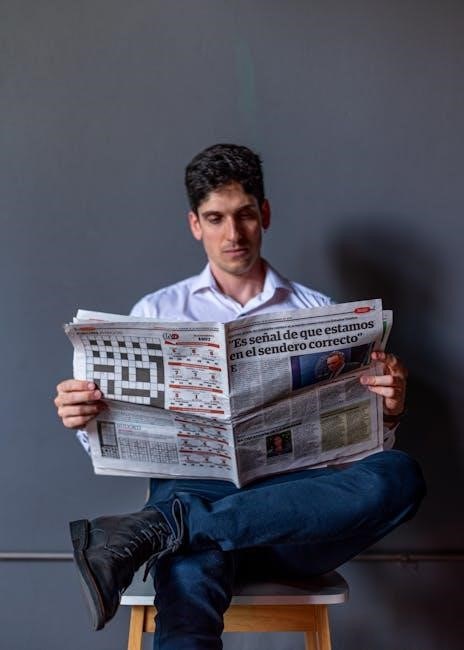
Cross-references, often indicated by phrases like “see X across” or “as in Y down,” are powerful solving tools. These clues direct you to another answer within the grid, providing a crucial intersection point. The referenced answer acts as a confirmation or a starting point for deciphering the original clue.
Effectively utilizing cross-references requires careful attention to detail and a systematic approach. Solve the referenced clue first, then use that answer to inform your attempt at the original. This technique is particularly helpful when facing ambiguous or challenging clues, offering a valuable foothold in the puzzle.
Considering Verb Tenses
Puzzle makers often exploit the multiple forms of verbs to create deceptive clues. A single verb can appear in present, past, or future tense, potentially altering the answer. Recognizing this trick is crucial for successful solving, especially in cryptic crosswords where wordplay is prevalent.
For example, the clue “Put away” could accept either “STORE” or “STORED,” depending on the intended tense. Carefully analyze the clue’s context and consider all possible verb forms before committing to an answer. This attention to grammatical nuance can unlock solutions that might otherwise remain elusive.
The Importance of Crossword Puzzle Rules
Crossword construction isn’t arbitrary; it adheres to established rules, broadly categorized as Ximenean or Libertarian styles. Ximenean puzzles, exemplified by The Times, prioritize grammatical precision and consistent cryptic device application, aiding unraveling clue structure. Libertarian styles, like The Guardian’s, embrace rule-bending for increased enjoyment.
Furthermore, “double puzzles” exist, presenting both definition and cryptic clues for the same answer grid, adding complexity. Understanding these stylistic differences and recognizing double puzzles enhances solving skills and appreciation for the puzzle’s artistry. Rule adherence impacts fairness and solvability.
Ximenean vs. Libertarian Styles
Ximenean crosswords, named after Ximenes, a renowned setter, strictly adhere to grammatical rules and consistent cryptic device presentation. This style prioritizes fairness and logical deduction, making clue structure easier to unravel for solvers. The Times and Financial Times exemplify this approach, valuing precision above all else.
Conversely, Libertarian styles, favored by publications like The Guardian and Daily Mail, allow for more flexibility and rule-breaking. While potentially more challenging, they often prioritize amusement and creativity. This approach can introduce ambiguity, but enhances the puzzle’s playful nature.
Double Puzzles
Double puzzles represent a fascinating complexity within crossword construction, offering solvers two distinct sets of clues for the same answer grid. One set provides straightforward definitions, while the other employs intricate cryptic wordplay. This duality caters to diverse solving preferences, appealing to both traditional and cryptic enthusiasts.
Essentially, a single grid accommodates two complete crosswords, demanding a broader skillset from the solver. Recognizing this structure is key; it’s a feature often found in publications like The Times, adding an extra layer of challenge and rewarding those who can navigate both clue types effectively.
The Future of Crosswords
The future of crosswords appears bright, with ongoing innovation blending tradition and technology. We can anticipate increased personalization, adaptive difficulty levels, and interactive digital experiences. Instructional crosswords, in particular, will likely see greater integration into educational platforms, offering tailored learning paths.
Furthermore, expect more collaborative puzzle creation and solving, leveraging online communities. Artificial intelligence may assist in grid design and clue generation, while maintaining the core challenge. The enduring appeal of crosswords lies in their ability to evolve, remaining a stimulating and accessible pastime for generations to come.